Please note: Product availability and information are based on our research at time of writing and are subject to change. Always check Amazon for the latest details before purchasing.
Introduction
Plastic pipe does not respond to a rotary tubing cutter the way copper does. Run a wheel-style cutter around PVC or PEX and it tends to crush the wall, roll a lip inward, and leave the pipe out of round — none of which you want on a joint you are about to solvent-weld. A dedicated PVC cutter uses a blade instead: a ratchet, single-stroke, or rotating shear action that slices straight through the wall and leaves a clean, square face. That square cut is what lets a fitting seat to full socket depth for a proper solvent bond, and a blade cut leaves no burr to scrape cement off the pipe on the way in. It is also faster for repeat cuts on a repipe. Below are five plastic-pipe cutters worth owning; if you also need to cut copper or metal pipe, see our full pipe cutter guide, which covers those separately.
✏️ Our Take
A cutter built for plastic pipe makes a cleaner, squarer cut than a rotary tubing cutter and will not crush or oval the wall — which matters most when the joint is solvent-welded and needs full socket contact. The main decisions are cutting capacity against your pipe size and schedule (most hand cutters are rated for Schedule 40; thick-wall Schedule 80 asks more of them), the cutting mechanism (ratchet for the most capacity with the least effort, single-stroke for speed on smaller pipe, rotating shear for the cleanest chip-free finish), and whether the blade is replaceable. A mid-capacity ratcheting cutter covers most residential PVC, CPVC, and PEX work. Shear-style tools cost more but leave the best cut; compact ratchet cutters suit tight-space, small-diameter runs. Once you’ve picked a cutter, our how to cut PVC pipe straight and clean guide covers technique, and our PVC Schedule 40 vs Schedule 80 comparison is worth a look if you’re not sure which wall thickness your project calls for.
Quick Comparison Table
Full Reviews — 5 Best PVC Pipe Cutters
1. SHALL PVC Pipe Cutter — Best Overall
🏆 Best Overall
The SHALL is the cutter to reach for on a typical residential job. Its ratcheting jaw handles PVC, CPVC, PEX, PPR, and rubber hose up to roughly 1-5/8 inches, which covers the vast majority of supply and small drain work a homeowner or remodeler runs into. The ratchet action is the reason it earns the top spot: each squeeze advances the SK5 carbon-steel blade a step further through the wall, multiplying your hand force so thicker Schedule 40 pipe cuts without a fight and without you having to muscle through in one stroke.
Build quality is better than the price suggests. The blade is hardened and, more importantly, replaceable, so a well-used cutter gets a new edge instead of a trip to the store. The body is aluminum alloy — light in a tool bag, corrosion-resistant around wet work — and the handle has a spring return and a locking catch so it stores closed. The cut face comes off square and clean enough to solvent-weld after a quick deburr. If you buy one plastic-pipe cutter, this is the sensible one.
✓ Pros
Ratchet mechanism cuts thick-wall Schedule 40 pipe with modest hand effort
Handles PVC, CPVC, PEX and PPR up to about 1-5/8 inches — one tool for most of the house
Replaceable SK5 blade and low price tier make it easy to live with
✗ Cons
Ratcheting takes several squeezes per cut — slower than a single-stroke tool on small pipe
Aluminum body flexes more than a forged-steel cutter under heavy daily use
🛒 Check Price on Amazon — $ →
2. Bates PVC Pipe Cutter — Best Budget
💰 Best Budget
The Bates covers the same basic idea as the SHALL for a little less money: a ratcheting plastic-pipe cutter with an SK5 blade that works through PVC, PEX, PPR, and CPVC up to about 1-1/4 inches. For a homeowner who cuts pipe a few times a year — a sprinkler repair, an under-sink swap, a length of PEX — it does the job a hacksaw would, faster and squarer, at the lowest price in this lineup.
It is a lighter-duty tool and it feels like one. The blade is replaceable, which matters because the edge is the first thing to go, but the jaw and pivot carry more play than the pricier cutters here, and the ratchet can leave a small ridge if you relax your grip mid-cut. The handles are comfortable enough for a handful of cuts; a full repipe would wear your hand out. Within its lane — occasional, smaller-diameter work — it is honest value.
✓ Pros
Lowest price tier here for a genuine ratcheting plastic-pipe cutter
Cuts PVC, CPVC and PEX up to about 1-1/4 inches — enough for most repair jobs
Replaceable blade rather than a sealed throwaway tool
✗ Cons
More pivot play and flex than the higher-tier cutters; not built for daily use
Can leave a slight ridge if grip is released partway through the ratchet stroke
🛒 Check Price on Amazon — $ →
3. RIDGID 23488 PC-1250 Plastic Pipe and Tubing Cutter — Best for Fast, Repeat Cuts
⚡ Best for Fast, Repeat Cuts
The PC-1250 is a single-stroke cutter: one full squeeze of the handle drives the blade clean through the pipe in a single motion, no ratcheting. Within its capacity — PEX, PE, PP, and PVC up to 1-1/4 inches — that makes it the fastest tool here. On a repipe where you are making the same 1/2-inch or 3/4-inch PEX cut dozens of times, cut-and-release in one stroke adds up to real time saved over a multi-squeeze ratchet.
It is a RIDGID hand tool, which shows in the detail: a hardened, replaceable blade, a stop that keeps the cut square, and a handle latch for storage. The trade is hand strength — a single stroke through 1-1/4-inch Schedule 40 asks for a firm grip, and anyone with less hand strength will find the ratchet tools easier past the 1-inch mark. Kept to 1-inch-and-under plastic, it is quick, clean, and durable enough to be the cutter that lives in the van.
✓ Pros
One-squeeze single-stroke cut is the fastest here for repeat work within capacity
RIDGID build: hardened replaceable blade, square-cut stop, storage latch
Clean, chip-free face on PEX and small PVC, ready to deburr and glue
✗ Cons
Needs firm hand strength near its 1-1/4-inch limit
Lower capacity than the ratcheting cutters — not for pipe above 1-1/4 inches
🛒 Check Price on Amazon — $$ →
4. KNIPEX BiX Cutter for Plastic Pipes — Best for Clean, Shaving-Free Cuts
✨ Best for Clean, Shaving-Free Cuts
The KNIPEX BiX works differently from everything else here. You clamp it around the pipe and rotate the whole tool; a blade fed in by a thumbwheel shears progressively through the wall as it travels around the circumference. The result is a genuinely square, chip-free, burr-free cut with almost no deformation of the pipe — the finish a solvent-weld joint wants, with no cleanup. It also reaches further than the hand cutters, taking composite and plastic pipe up to roughly 2 inches.
This is German-made KNIPEX, and the build and the price both reflect that — it sits at the top tier here. The blade is replaceable and holds an edge well through plastic and multilayer pipe. The rotating action needs clear space around the pipe to swing the tool, so it is happier on open runs than buried in a stud bay, and each cut takes more motion than a quick squeeze. For anyone who values cut quality above all — or regularly cuts larger-diameter plastic — it is the best tool in this roundup.
✓ Pros
Rotating shear leaves a square, chip-free, burr-free face with no deformation
Highest capacity here — composite and plastic pipe up to roughly 2 inches
KNIPEX build quality with a replaceable, long-lasting blade
✗ Cons
Highest price tier in this lineup
Needs clearance to rotate around the pipe and takes more motion per cut than a squeeze cutter
🛒 Check Price on Amazon — $$$ →
5. RIDGID 23498 RC-1625 Ratchet Action Plastic Pipe Cutter — Best for Small-Diameter Pipe
🔧 Best for Small-Diameter Pipe
This is the same compact cutter we feature as the small-diameter specialist pick in our broader pipe cutter guide — we are not presenting it as a different tool here. In that guide it stands in for plastic among mostly copper cutters; in this all-plastic lineup it earns a narrower job. The RC-1625 is a ratchet-action cutter built for PEX and plastic pipe up to about 1-5/8 inches, and where it shines is the small, everyday stuff: 1/2-inch and 3/4-inch PVC, CPVC, and PEX, cut one-handed in a tight space.
The body is compact enough to work inside a cabinet or a joist bay where the KNIPEX cannot swing and the longer-handled cutters are awkward. The blade is replaceable and the ratchet advances smoothly, so small-diameter cuts come off square with light effort. It is not the tool for a full repipe of larger pipe — the capacity and short handles limit it there — but if your work is entirely PVC and plastic and you want the most compact, precise cutter for smaller-diameter supply lines in confined spaces, this is the most controllable option in the roundup.
✓ Pros
Compact head works one-handed in cabinets and stud bays where bigger cutters can’t
Smooth ratchet gives square, low-effort cuts on 1/2-inch and 3/4-inch pipe
Replaceable blade and RIDGID durability
✗ Cons
Short handles and 1-5/8-inch capacity limit it on larger pipe and full repipes
Same tool covered in our main pipe cutter guide — little reason to own both
🛒 Check Price on Amazon — $ →
Buying Guide
Cutting capacity vs pipe schedule
Hand cutters are rated by outside diameter, and that rating assumes Schedule 40. Schedule 80 pipe carries a thicker wall at the same OD, so a cutter that breezes through 1-inch Schedule 40 will struggle — or deform the pipe — on 1-inch Schedule 80. Stay a size below the stated capacity when the wall is thick, and switch to a saw for Schedule 80 much above 1 inch. Match the tool to the biggest pipe you cut regularly, not the largest you might cut once.
Ratchet vs single-stroke vs shear
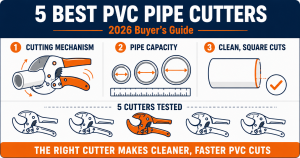
Three mechanisms, three trade-offs. A single-stroke cutter such as the RIDGID PC-1250 cuts in one squeeze — fastest for repeat cuts, but limited in capacity and demanding on hand strength. A ratcheting cutter such as the SHALL, the Bates, or the RC-1625 advances the blade a step per squeeze, multiplying force so you can cut bigger, thicker pipe with less effort, at the cost of several strokes per cut and an occasional ridge if you release mid-stroke. A rotating shear such as the KNIPEX BiX drives the blade around the pipe for the cleanest, least-deformed cut of all, but needs swing clearance and more motion. Choose by whether speed, capacity, or cut quality matters most.
Blade replacement and sharpening
The blade is the wear part. A sharp blade slices; a dull one crushes, wanders off square, and leaves a ragged lip. Every cutter here takes a replaceable blade, and replacing is the right move — these hardened, thin-profile blades are hard to re-sharpen well by hand, though a few light passes on a fine stone buy some time. Dulling comes fastest from cutting the wrong material, so never put a plastic-pipe blade on metal, wire, or nails. Keep a spare blade with the tool.
Why a square cut matters for solvent-welded joints
A PVC or CPVC solvent-weld joint gets its strength from full contact between the pipe and the fitting socket. A cut that is off-square or out-of-round only touches part of the socket, which shrinks the bonded area and leaves a path for a leak under pressure. A burr or ragged edge is worse — it scrapes cement off the pipe as the fitting goes on and can channel solvent out of the joint. A clean, square, lightly chamfered and deburred end seats to full depth and beds evenly in the cement. This is the single biggest reason a blade cutter beats a rotary wheel on plastic.
Aluminum vs steel body
A cutter’s frame is usually aluminum alloy or forged, hardened steel. Aluminum is lighter, rust-resistant, and fine for DIY and light professional use — the SHALL is a good example. A steel frame flexes less when you cut near the capacity limit and holds up better to daily jobsite abuse, but it is heavier in the bag. For occasional home use, aluminum is plenty; for a plumber cutting plastic every day, the stiffer steel frame earns its weight.
Frequently Asked Questions
Q: Can I use a PVC pipe cutter on CPVC?
Usually yes, on smaller diameters and with a sharp blade. CPVC cuts much like PVC, but it is more brittle — especially when cold — so a dull blade or a fast, forced cut can crack or star-fracture the pipe end. Let the ratchet do the work, keep the blade fresh, and if the pipe is cold, warm it in your hands first. For CPVC above about 1 inch, or any time the cut looks like it is stressing the pipe, a fine-tooth saw is the safer choice. Deburr and chamfer either way before solvent-welding. Our PVC vs CPVC comparison explains the material differences in more detail.
Q: What size PVC can these cutters handle?
The hand cutters here top out between 1-1/4 inches (RIDGID PC-1250) and about 1-5/8 inches (SHALL, RIDGID RC-1625) of outside diameter on Schedule 40 pipe. The KNIPEX BiX reaches furthest, to roughly 2 inches on plastic and composite pipe. Those numbers assume standard-wall pipe; thick-wall Schedule 80 effectively drops each tool a size. For most residential supply lines and small drains — 1/2 inch through 1-1/2 inch — any of these covers you. Above 2 inches, you are into saw territory.
Q: Do I still need a hacksaw for large-diameter pipe?
Yes. Hand cutters do not reach the 2-inch, 3-inch, and 4-inch pipe used for DWV and drain lines, and no ratcheting cutter is practical at that size. For those, a fine-tooth hacksaw, a handsaw, or a reciprocating or miter saw with a fine blade is the tool, followed by a chamfer and a thorough deburr so the fitting still seats cleanly. If you are weighing drain materials in an older home, our cast iron vs PVC drain pipe comparison covers what you are likely cutting into.
Q: How long do the blades last?
There is no fixed cycle count, but a quality SK5 or hardened blade will make a lot of Schedule 40 cuts — well into the hundreds — before it needs replacing for occasional use. You will feel the change before you see it: the cut takes more force, the blade wants to wander off square, and the edge of the pipe starts to crush or feather instead of slicing. That is the cue to drop in a fresh blade. Cutting anything harder than plastic — a stray screw, a pipe with grit baked on — will dull an edge in a single stroke, so keep the blade to clean plastic pipe only.
Conclusion — Which PVC Pipe Cutter Should You Buy?
For most people cutting plastic pipe around the house, the SHALL PVC Pipe Cutter is the pick. It ratchets through PVC, CPVC, and PEX up to about 1-5/8 inches with little effort, the SK5 blade is replaceable, and it costs the least of the tools that can do all of that. It is the one-cutter answer for a typical home, and the reason it takes Best Overall here.
If you only cut pipe occasionally, the Bates PVC Pipe Cutter does the same job on smaller pipe for even less. On a repipe where speed matters, the single-stroke RIDGID PC-1250 is quickest within its 1-1/4-inch range. For the cleanest possible cut, or for plastic pipe up to 2 inches, the KNIPEX BiX is the best tool here and priced accordingly. And for small-diameter work in tight spaces, the compact RIDGID RC-1625 — the same cutter from our main pipe cutter guide — is the most controllable. Whichever you choose, keep a spare blade with it and deburr every cut before you glue.
Prices and ratings may change. Always check Amazon for current prices.
✍️ About This Review
PTR Editorial Team — Product Reviews. We compare manufacturer specifications, installation requirements, compatibility and available product documentation to help homeowners choose suitable tools and parts. How we review →